• UGM
  • IT Center
  • English
    • English
    • Bahasa Indonesia
Universitas Gadjah Mada Master Program of Linguistics
Faculty of Cultural Sciences
Universitas Gadjah Mada
  • Home
  • About
    • HISTORY
    • VISION&MISSION
    • Organizational Structure
  • ADMISSION
  • Curriculum
  • ALUMNI PROFILE
  • LECTURERS
  • Home
  • News Release
Arsip:

News Release

Dialectology Fieldwork: UGM Linguistics Graduate Students Study Javanese Language Variations in Magelang

Agenda ENNews Release Wednesday, 10 June 2026

Students of the Dialectology class from the Master’s Program in Linguistics, Faculty of Cultural Sciences, Universitas Gadjah Mada conducted a fieldwork program in Ngablak District, Magelang Regency, Central Java, as part of strengthening their linguistic research competencies. The activity focused on the study of Javanese dialect variations based on the geographical and social aspects of its speech communities.

Javanese is one of the regional languages with the largest number of speakers in Indonesia and is widely spoken across various parts of the archipelago. Through this fieldwork program, the students carried out dialectological research to observe the phonological, lexical, and semantic variations of Javanese used by communities in five villages in Ngablak District, namely Ngablak, Seloprojo, Genikan, Kanigoro, and Tejosari. These areas were selected due to their highland geographical characteristics, where vegetable farming serves as the primary economic activity of the local communities.

The social and geographical characteristics of the Ngablak community are considered to have a strong influence on the development of language variation. The communication patterns of agrarian communities, differences in altitude, and the geographical conditions of mountainous areas potentially contribute to the emergence of distinctive lexical variations, particularly those related to agricultural terminology and local wisdom.

The research was conducted through direct interviews with local residents using a 200-word Swadesh list as the research instrument. Conversations between the students and informants were recorded with the consent of the participants as part of the linguistic data documentation process. The recorded data were then transcribed phonetically to identify lexical variations found in each research location.

Furthermore, the collected linguistic data will be analyzed using dialectometric methods to map the levels of similarity and difference among dialects across villages. Through this activity, students not only gained direct experience in field-based linguistic research but also contributed to the documentation and mapping of regional language diversity in Indonesia.

This Dialectology fieldwork program reflects the commitment of the UGM Master’s Program in Linguistics to developing research-based learning while strengthening linguistic studies oriented toward the preservation of local languages and cultures.

Psycholinguistics Course: Understanding Language through the Perspectives of Mind, Brain, and Human Behavior

Agenda ENNews Release Wednesday, 20 May 2026

The Psycholinguistics course is designed to provide students with an in-depth understanding of the relationship between language, the mind, and human biological processes. Through this course, students are introduced to the ways in which humans, as subjects, utilize their neurobiological capacities to process language as an object, while also examining the various obstacles that may arise in such processes.

The course materials encompass the study of humans as biological beings possessing the brain, neurological systems, auditory and visual senses, and speech organs that play essential roles in language processing. In addition, students explore the nature of human language and the various stages of linguistic processing, including language perception and comprehension, first language acquisition, second and foreign language learning, memory storage and retrieval processes, as well as spoken and written language production.

Beyond focusing solely on typical language processes, the Psycholinguistics course also addresses a range of language impairments and disorders caused by neurological and biological abnormalities. Through this approach, students are expected to develop a more comprehensive understanding of language from cognitive, biological, and social perspectives.

The course is delivered through a combination of face-to-face and blended learning modes in accordance with faculty guidelines. The instructional format consists of 60 percent in-person learning and 40 percent blended learning. Indonesian is used as the primary language of instruction throughout the course.

As part of strengthening students’ academic competencies and analytical skills, assessment is conducted through assignments and quizzes weighted at 20 percent, as well as article writing based on a case-based learning approach weighted at 80 percent. This approach encourages students to relate psycholinguistic theories to real linguistic phenomena occurring in society.

Another distinctive feature of the course is the student presentation sessions conducted in their respective regional languages to discuss specific topics related to psycholinguistics. This activity not only enriches students’ academic perspectives on Indonesia’s linguistic diversity, but also serves as a reflective space for understanding the relationship between language, culture, and human cognitive processes.

Through the Psycholinguistics course, students are expected to develop an interdisciplinary understanding of language as part of the human cognitive system, while simultaneously enhancing their sensitivity to linguistic diversity and various language-related issues encountered in everyday life.

Tracing Language, Sustaining Culture: Fieldwork of Anthropological Linguistics B in Temanggung

Agenda ENNews Release Wednesday, 13 May 2026


The Master’s Program in Linguistics at Universitas Gadjah Mada organized a fieldwork program for students of the Anthropological Linguistics B class as part of its effort to strengthen research-based academic competencies. This activity was designed to provide students with direct experience in examining the relationship between language and the sociocultural life of communities, particularly within the context of agrarian society in Temanggung Regency, Central Java.

As an interdisciplinary field of study, anthropological linguistics does not merely focus on linguistic structures, but also investigates the interconnections between language and social practices, belief systems, local knowledge, and human interaction with the environment. Through this approach, language is understood as an integral part of culture that both records and shapes social reality. Therefore, anthropological linguistic inquiry plays a crucial role in efforts to understand and preserve sociocultural diversity, especially in Indonesia, a country characterized by its vast linguistic and cultural richness.

Temanggung Regency was selected as the fieldwork site due to its strong potential for anthropological linguistic research. Situated in a highland area flanked by Mount Sindoro and Mount Sumbing, the people of Temanggung are known for their close relationship with the natural environment. Agricultural practices passed down through generations not only produce leading commodities but also form local knowledge systems reflected in the community’s lexicon and discourse.

In the Kledung area, for instance, tobacco and coffee constitute primary commodities that are deeply embedded in daily life. The process of tobacco cultivation, from seedling to harvest, reflects rich agricultural cultural knowledge. Similarly, the processing of Kledung’s distinctive Arabica coffee, which has obtained Geographical Indication status, presents a unique set of lexicon that reflects local knowledge and community adaptation to the highland environment.

Meanwhile, in Manding, cassava plays a significant role in the local food industry. Community perspectives on cassava extend beyond its function as a food source, representing values of local food resilience transmitted across generations. In Gemawang, the tradition of sugar palm processing—particularly in the production of palm sugar—demonstrates a close relationship between language, economic practices, and local history. The lexicon associated with sap tapping, traditional tools, and derivative products constitutes an important component of linguistic documentation that deserves preservation.

Through this fieldwork program, students are expected to produce several research outputs, including: (1) the lexicon of coffee processing in Kledung, (2) ethnobotanical knowledge of tobacco among the Kledung community, (3) community perspectives on cassava in Manding, and (4) the lexicon of sugar palm agriculture in Gemawang. These research outcomes are expected to contribute significantly to the development of anthropological linguistics while also supporting efforts to preserve local languages and cultures amid ongoing modernization.

This activity reaffirms the commitment of the Master’s Program in Linguistics at Universitas Gadjah Mada to integrating theoretical learning with field-based practice, as well as encouraging students to actively engage in research that is relevant to societal dynamics.

Master’s Program in Linguistics Conducts Field Study in Semarang, Examining Linguistic Landscapes and Cultural Interaction

Agenda ENNews Release Wednesday, 29 April 2026

The Master’s Program in Linguistics organized a field study for the course Anthropological Linguistics A on April 25, 2026, in the Pecinan and Kota Lama areas of Semarang, Central Java. This activity forms part of an academic initiative to integrate theoretical knowledge with field-based practice through direct observation of linguistic phenomena in public spaces.

The areas of Pecinan, Kota Lama, and Pasar Johar were selected as research sites due to their rich colonial history and complex cultural acculturation. These locations represent the intersection of Chinese, Arab, Javanese, and European cultures, which collectively shape Semarang’s distinctive identity. In terms of linguistic landscape, the Pecinan area demonstrates a dominance of Mandarin on shop signage, reflecting the strong ethnic identity and ideological presence of the Chinese community. In contrast, the Kota Lama area predominantly features Indonesian and English as languages of tourism, despite its deeply rooted colonial past.

Linguistic phenomena in public spaces are closely intertwined with economic interests, ideological expressions, and the negotiation of social identity. Beyond the visual landscape, spoken interactions in areas such as Pasar Johar also reveal compelling dynamics. Traders and buyers frequently engage in code-switching between Javanese (ngoko and krama), Indonesian, and localized Semarang vocabulary. This practice reflects social solidarity and interethnic familiarity in everyday communication.

Spatial functions also influence the linguistic landscape temporally. During the daytime, Pasar Johar is dominated by local interactions using Javanese and Indonesian. By contrast, in the evening, the area transforms into a culinary hub characterized by illuminated signage in Indonesian and English targeting younger visitors and tourists. This shift highlights the dynamic and contextual nature of linguistic landscapes.

From a methodological perspective, students encountered challenges in interpreting cross-script linguistic signs, particularly the use of Hanzi characters in the Pecinan area, which are not always accompanied by Latin transliteration. This condition provides opportunities for deeper analysis of signs as symbols of cultural identity rather than merely informational tools.

The field study aims to enhance critical thinking and research interest among the 2025 cohort of Master’s students in Linguistics, document local wisdom within the community, and apply anthropological linguistic theories in real-world contexts. Students were divided into four groups, each consisting of four to five members, to conduct field observation and data collection.

As an expected outcome, the activity targets the development of a draft book chapter comprising four scholarly articles based on students’ research. Each article addresses a distinct topic derived from findings in the Pecinan and Kota Lama areas.

Through this activity, students are expected to gain a comprehensive understanding of the relationship between language, culture, and public space, while also producing meaningful scholarly contributions to the field of anthropological linguistics.

CALL FOR PAPERS AND PARTICIPATION INTERNATIONAL CONFERENCE ON LINGUISTIC STUDIES

Agenda ENNews Release Thursday, 16 April 2026

The Master’s Program in Linguistics and the Department of Language and Literature, Faculty of Cultural Sciences, Universitas Gadjah Mada, cordially invite academics, researchers, and practitioners in the field of language studies to submit abstracts and participate in the International Conference on Linguistic Studies entitled “Form, Meaning, and Function of Language in the Era of Digital Transformation.”

This conference aims to provide an international forum for the dissemination and discussion of current research addressing the evolving roles of language in contemporary society, particularly in the context of rapid digital transformation.

Valedictory Address
Prof. Dr. I Dewa Putu Wijana

Keynote Speakers

  • Zara Maxwell-Smith — University of New South Wales, Australia
  • Jérôme Samuel — Institut National des Langues Orientales (INALCO), France
  • Nguyen Tanh Tuan — Vietnam National University, Vietnam
  • Xu Yun Yu — Tianjin Foreign Studies University, China
  • Suhandano — Universitas Gadjah Mada, Indonesia

Date
Thursday–Friday, 10–11 September 2026

Venue
Faculty of Cultural Sciences, Universitas Gadjah Mada

Registration and Abstract Submission
ugm.id/regisling

Important Dates

  • Abstract Submission Deadline: 30 May 2026
  • Full Paper Submission Deadline: 31 July 2026
  • Participant Registration Deadline: 30 August 2026

Contact Information

WhatsApp: wa.me/+6281125113370
Email: bahasadansastra.fib@ugm.ac.id

Conference Overview

Linguistic inquiry has historically been characterized by analyses of form, meaning, and function within predominantly formalist frameworks. In recent decades, however, the field has increasingly embraced functionalist perspectives, wherein language is examined not only as a system to be described but also as a dynamic resource for communication and for representing social, political, and cultural realities.

Contemporary linguistic studies have expanded across disciplinary boundaries, engaging with fields such as communication studies, semiotics, anthropology, law, and medicine. This shift reflects a broader movement from an emphasis on langue toward parole—or “language in use”—highlighting language as it operates in real-world contexts.

Moreover, the rapid advancement of communication technologies in the era of digital transformation has further extended the functions of language, particularly within digital and social media environments. In response to these developments, the Faculty of Cultural Sciences, Universitas Gadjah Mada, convenes this international conference as a platform for scholarly exchange and critical engagement.

This conference is also organized in honor of the retirement of Prof. Dr. I Dewa Putu Wijana, S.U., M.A., whose distinguished body of work—spanning books and scholarly articles published in national and international journals—has significantly contributed to the advancement of linguistic studies. The conference theme reflects and celebrates his academic legacy.

INTERNATIONAL CONFERENCE ON LINGUISTIC STUDIES

Agenda ENNews Release Thursday, 16 April 2026

The Master’s Program in Linguistics and the Department of Language and Literature, Faculty of Cultural Sciences, Universitas Gadjah Mada, cordially invite academics, researchers, and practitioners in the field of language studies to submit abstracts and participate in the International Conference on Linguistic Studies entitled “Form, Meaning, and Function of Language in the Era of Digital Transformation.”

This conference aims to provide an international forum for the dissemination and discussion of current research addressing the evolving roles of language in contemporary society, particularly in the context of rapid digital transformation.

Valedictory Address
Prof. Dr. I Dewa Putu Wijana

Keynote Speakers

  • Zara Maxwell-Smith — University of New South Wales, Australia
  • Jérôme Samuel — Institut National des Langues Orientales (INALCO), France
  • Nguyen Tanh Tuan — Vietnam National University, Vietnam
  • Xu Yun Yu — Tianjin Foreign Studies University, China
  • Suhandano — Universitas Gadjah Mada, Indonesia

Date
Thursday–Friday, 10–11 September 2026

Venue
Faculty of Cultural Sciences, Universitas Gadjah Mada

Registration and Abstract Submission
ugm.id/regisling

Important Dates

  • Abstract Submission Deadline: 30 May 2026
  • Full Paper Submission Deadline: 31 July 2026
  • Participant Registration Deadline: 30 August 2026

Contact Information

WhatsApp: wa.me/+6281125113370
Email: bahasadansastra.fib@ugm.ac.id

Conference Overview

Linguistic inquiry has historically been characterized by analyses of form, meaning, and function within predominantly formalist frameworks. In recent decades, however, the field has increasingly embraced functionalist perspectives, wherein language is examined not only as a system to be described but also as a dynamic resource for communication and for representing social, political, and cultural realities.

Contemporary linguistic studies have expanded across disciplinary boundaries, engaging with fields such as communication studies, semiotics, anthropology, law, and medicine. This shift reflects a broader movement from an emphasis on langue toward parole—or “language in use”—highlighting language as it operates in real-world contexts.

Moreover, the rapid advancement of communication technologies in the era of digital transformation has further extended the functions of language, particularly within digital and social media environments. In response to these developments, the Faculty of Cultural Sciences, Universitas Gadjah Mada, convenes this international conference as a platform for scholarly exchange and critical engagement.

This conference is also organized in honor of the retirement of Prof. Dr. I Dewa Putu Wijana, S.U., M.A., whose distinguished body of work—spanning books and scholarly articles published in national and international journals—has significantly contributed to the advancement of linguistic studies. The conference theme reflects and celebrates his academic legacy.

Kalingga UGM Presents Reading Corner and Literacy Program in RPKJ Satunama

Agenda ENNews Release Tuesday, 31 March 2026

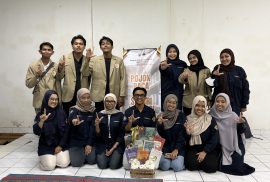
On Saturday, March 7, 2026, the Linguistics students and members Keluarga Mahasiswa Linguistik Universitas Gadjah Mada (Kalingga), held an activity titled “Pembuatan Pojok Baca Binaan Kalingga dan Safari Literasi”  or the Establishment of the Kalingga-Assisted Reading Corner and Literacy Safari at the Satunama Mental Health Learning House (RPKJ Satunama). This activity is part of the work program of Kalingga’s Social and Community Action Division (Aksosma), which focuses on strengthening literacy while empowering communities through a humanistic and inclusive approach.

This program was organized as an effort to create an inclusive space that is supplementary to the psychosocial recovery process of the assisted residents (WD) of RPKJ Satunama. In this activity, Kalingga students collaborated with the management of RPKJ Satunama to organize a reading corner that can be used as a learning space, a reflection space, and a space for interaction among the assisted residents.

The presence of Kalingga students was warmly welcomed by both the staff and the assisted residents of RPKJ Satunama. Enthusiasm was evident from the beginning of the activity, as students and residents worked together to arrange bookshelves, categorize reading materials, and prepare the reading corner to make it comfortable for use.

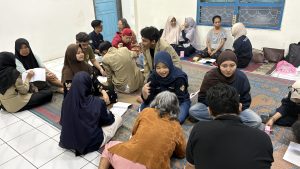
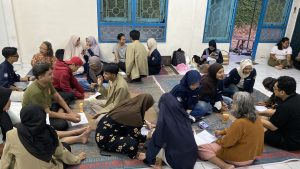
In addition to setting up the reading corner, the series of activities also included Safari Literasi. In this activity, Kalingga members invited residents to participate in various interactive activities such as educational games, simple writing exercises, storytelling sessions, and light discussions. These activities were designed to provide an enjoyable literacy experience while fostering a sense of togetherness.

Through this approach, literacy is not only understood as reading and writing activities, but also as a means to rebuild self-confidence, create a space for expression, and strengthen social relationships between the assisted residents and their surrounding environment.

The Head of Kalingga UGM, Moh. Nawalul Fawaid El Haqi, stated that this activity is part of the students’ commitment to delivering social programs that have a real impact on society. According to him, community service activities like this are important for fostering a sense of care and empathy among students, while also serving as an implementation of humanitarian values in social life.

“We hope that the program designed by the Aksosma Division can become a concrete and sustainable initiative. We also hope that this activity can inspire compassion among people and strengthen the value of togetherness within society,” he said.

Meanwhile, the Head of Kalingga’s Aksosma Division, Abu A.K., explained that literacy can be an effective approach in supporting the psychosocial recovery process of assisted residents. He stated that literacy plays an important role in helping individuals understand their life experiences, express their feelings, and build new hope. “Literacy is not just about reading and writing, but also about creating a space for hope. Through this activity, we aim to provide a space that allows assisted residents to express themselves, share stories, and rebuild their spirit,” he said. Abu also hopes that the reading corner that has been established can continue to be utilized by the assisted residents in their daily activities at RPKJ Satunama.

The 2026 Student Gathering of Magister Linguistik and Kalingga Inauguration

Agenda ENNews Release Thursday, 12 February 2026

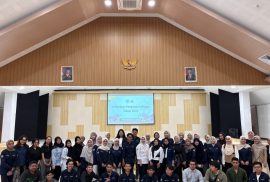
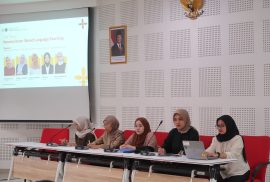
Magister Linguistik welcomes the new semester with a Student Gathering in Auditorium Gedung Poerbatjaraka on February 9th, 2026. This event plays a pivotal role in tightening the relationship between students and lecturers. The activity consisted of a presentation from the study program, which provided important information about academic regulations, research opportunities, and plans. In addition, the forum served as a space to gather various questions from active students of the Master’s Program in Linguistics. The new Head of Study Program, Dr. Hayatul Cholsy, S.S., M.Hum, and the Secretary of Study Program, Dr. Wira Kurniawati, MA. lead the lively discussion between the program and the students. This interactive session allowed students to express their concerns, share suggestions, and gain a clearer understanding of the program.

The event was attended by lecturers as well as students from the 2024 and 2025 cohorts. Their presence created a warm and engaging atmosphere, encouraging open discussion between students and faculty members. Rizky Alida, a student staff member, explains that, “although the gathering was conducted simply, I believe this forum is highly necessary for the future development of the study program. It strengthens communication and builds a sense of community among academic members.”

The newly elected head of Kalingga 2026, Moh. Nawalul Fawaid El Haqi, also expresses his aspirations for the student organization. “I hope Kalingga 2026 can become a real space for movement and collaboration, especially for students, to contribute actively to the advancement of the Master’s Program in Linguistics UGM.”

Neuroscience-Based Language Teaching: Bridging Brain, Emotion, and Classroom Practice

Agenda ENNews Release Thursday, 12 February 2026

On December 16th, 2025, a talk show on Neuroscience-Based Language Teaching was held at Room 709, Soegondo Building, Faculty of Cultural Sciences (FIB), Universitas Gadjah Mada. The event brought together Language Teaching students in Magister Linguistik, who share a common concern: how understanding the brain can improve language learning.

The first theme, Teaching Language through Gamification: A Neuroscience-Based Approach, emphasized the importance of creating a safe and engaging learning environment. Speakers highlighted the role of the amygdala, the part of the brain responsible for fear and stress responses. When students feel threatened or anxious, the amygdala becomes active, which can disrupt the hippocampus, or the brain’s center for memory formation.

This explains why students who appear passive or disengaged may actually be experiencing emotional barriers to learning. Through interpersonal communication and close observation, teachers can identify students’ preferred learning styles. One case shared by Fajriani Fitri illustrated how a stressed student with poor academic performance regained confidence after a visual-based learning approach was applied. As she noted, teaching language also means addressing students’ past failures and helping them believe in their own ability.

The second theme, Teaching with Emotion: How Affective Neuroscience Enhances Language Learning, focused on the emotional dimension of language education. Negative emotions, such as anxiety or trauma from previous learning experiences, can strongly affect students’ willingness to speak, especially in foreign languages. Therefore, teachers are encouraged to build interactive and emotionally supportive classrooms. By emphasizing action-based learning—such as practicing how to order food in English—students can focus on communication rather than fear of mistakes. Fluency is prioritized before accuracy to reduce anxiety and foster positive memories.

The discussion concluded by addressing adult learners, such as those preparing for TOEFL or IELTS. While adults have different emotional conditions and learning goals, emotional and interpersonal approaches remain relevant. Repeated practice, deductive teaching methods, and emotional awareness are key to engaging the limbic system and sustaining learning motivation. Ultimately, while methods may change, one constant remains: effective language teaching must reach both the mind and the heart of learners.


BULINGGA: A Space for Linguistic Voices and Public Engagement

Agenda ENNews Release Monday, 12 January 2026

Buletin Linguistik Gadjah Mada (BULINGGA) was born from a personal concern about the lack of accessible platforms dedicated to linguistic issues. BULINGGA’s editor-in-chief, Idatus Sholihah, stated that language is inseparable from social life, yet discussions on language often remain confined to newspapers or major online media, where strict curation limits who can publish. Responding to this gap, BULINGGA was initiated as an alternative publication space that provides information and fresh insights into linguistic developments while remaining open to diverse voices.

Designed in an engaging and reader-friendly format, BULINGGA features short articles, scholarly opinions, and highlights of linguistic research at both national and international levels. Each edition focuses on a specific theme. The first edition, Bahasa dan Budaya (Language and Culture), presented eight articles from eight contributors. It was followed by Bahasa dan Politik (Language and Politics) with six articles from seven contributors, Indigenous Language and Identity (Bahasa Daerah dan Identitas) with a significant increase to twelve articles from twelve contributors, and Bahasa dan Gender (Language and Gender), which featured eight articles by eight contributors. This progression reflects growing interest and participation in the bulletin.

Published regularly, BULINGGA serves as a space for sharing ideas, research findings, and relevant linguistic issues. Students, lecturers, linguists, language enthusiasts, and the general public are all welcome to contribute. The editorial process, from curation to publication, is dynamic and stimulating, as contributors explore the same issue from unique perspectives. While editorial challenges arise, particularly when submissions lack a clear linguistic focus, contributors remain enthusiastic and committed to future editions.

As a newly initiated platform, BULINGGA thrives on collective effort. With support from Kalingga colleagues handling layout, editing, and online distribution, the bulletin aims to foster a strong culture of literacy, broaden public access to linguistic knowledge, and ensure that linguistic discourse is not exclusive to academia.

Read all BULINGGA editions here:

bit.ly/BulinggaEdisiPertama

bit.ly/BulinggaEdisiKedua

bit.ly/BulinggaEdisiKetiga

bit.ly/BulinggaEdisiKeempat

123…6
Universitas Gadjah Mada

Master Program of Linguistics

Faculty of Cultural Sciences
Universitas Gadjah Mada
Jl. Nusantara 1, Bulaksumur Yogyakarta 55281, Indonesia
fib@ugm.ac.id
+62 (274) 513096
+62 (274) 550451

© 2023 Faculty of Cultural Sciences Universitas Gadjah Mada

KEBIJAKAN PRIVASI/PRIVACY POLICY